Project Profile
LandWatch for Institutional Control Monitoring
Industrial, Utility, and Government Clients
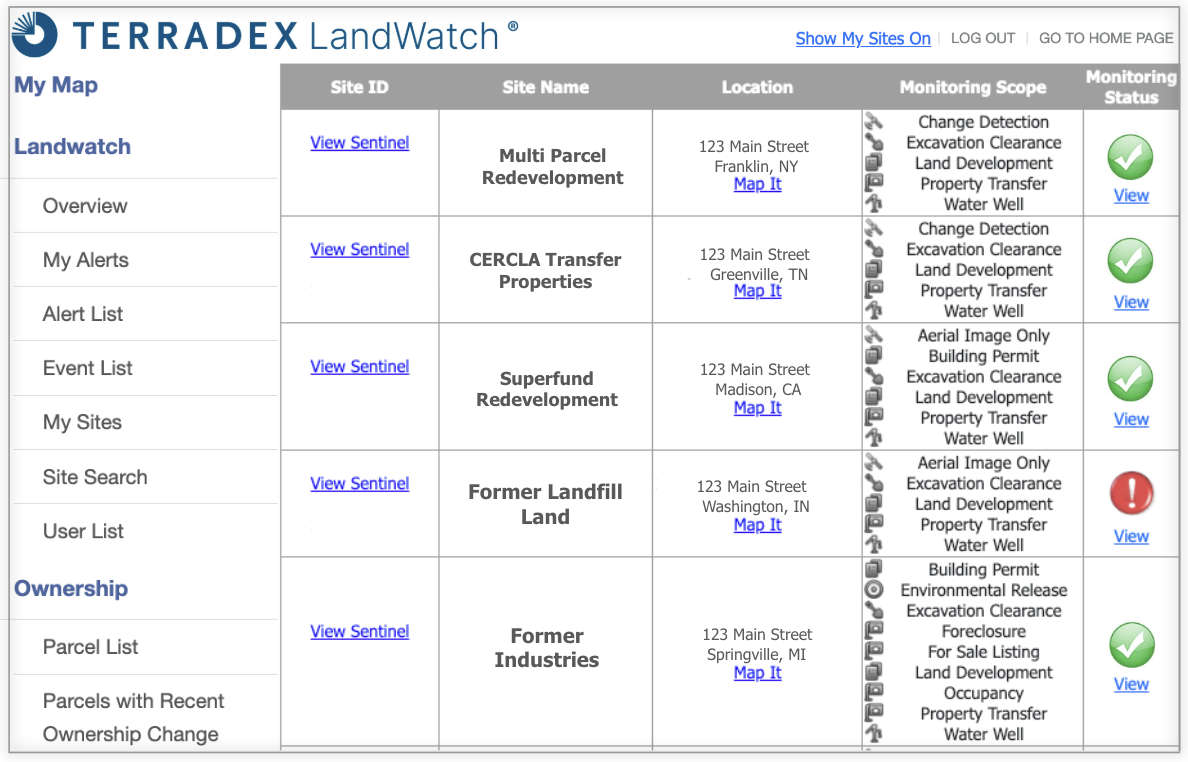
Primarily used for contaminated site stewardship, LandWatch® is a secure web service that has been in use for over 20 years by Fortune 500 companies, government agencies, utility companies, and many others. Providing proactive risk management and institutional control (IC) compliance, LandWatch monitors an enormous flow of public information data associated with land use and related activities, including property development, ownership transfers, excavation activities, well and building permit activities, zoning changes and variances, and more.
Clients use LandWatch across different use cases, ranging from large portfolios of complex IC sites to Superfund redevelopment sites to less complex single-site situations. In all cases, LandWatch provides an important, if not crucial, role in remediation, redevelopment, and long-term stewardship strategies.
A national-scale redevelopment client relies on LandWatch as a key piece for nearly all its deals. This client remediates complex sites, establishes ICs and engineering controls (ECs) for residual contamination, and sells the properties to redevelopers for reuse. As part of the client’s regulatory oversight obligations and the sale-for-reuse deal structure, LandWatch plays a crucial role. Usually beginning shortly after the sale to new redevelopers, but primarily put to use after redevelopment has been completed, the client relies on LandWatch to monitor for land-disturbing activity, land development, building and well permits, property transfers, and more. Using LandWatch, the client ensures that after the sale to new owners, all future activities comply with and do not affect the integrity of IC/ECs. This keeps people safe, protects the environment, and helps deals go forward.
A federal government agency client relies on LandWatch to manage its IC obligations at former federally owned property transferred under CERCLA 120(h) with ICs in place. In accordance with CERCLA, the government transferred large tracts of remediated but deed-restricted property (due to residual contamination and historic infrastructure) out of federal control for private-sector reuse, with significant revenue and job-creation impacts. The government retained long-term stewardship obligations. The LandWatch application houses and tracks the details and nuances of a complex set of ICs across many properties/deeds, as well as subsequent property transfers, and on an ongoing, even daily basis, monitors and tracks ground disturbances and land and water well permit activity for the agency. LandWatch also provides visibility to third-party stakeholders, including property owners and developers, which supports communication of critical information and further helps ensure IC/EC compliance.
A large utility company client in the Northeast integrated LandWatch into its existing One Call process, which historically had focused only on the company’s infrastructure. The integrated LandWatch sends alerts and provides visibility to the company’s environmental department to describe and highlight excavation activity that, in addition to potentially impacting the client’s underground utilities, could also affect contaminated media at the client’s environmentally impaired sites. These alerts and real-time visibility, in turn, allow the environmental department to impose soil management and similar safeguards when, in addition to affecting underground infrastructure, the activities would impact contaminated or other environmentally sensitive areas.
An industrial energy client, seeking to responsibly manage ICs and residual contamination, relies on LandWatch for its surplus property transfers nationwide. In one of many recent examples, LandWatch detected a combination of property ownership transfer and proposed land development activity at an adjacent property, which could have disturbed residual contamination. With this timely alert, the client was able to help ensure that proper safeguards were put in place, protecting people and the environment. In another recent example, satellite and drone imagery monitoring detected an anomaly in an asphalt cap, suggesting that an excavation had occurred and that the asphalt had been repaired. This monitoring information confirmed that the new site owner had indeed excavated soil beneath the cap. The client then implemented swift corrective measures.
At a California Superfund redevelopment site, the former owners and operators established a Trust to help ensure appropriate long-term stewardship after they sold the multi–parcel property for reuse. As a key component of its long-term stewardship process, the Trust relies on LandWatch. Among many other examples, LandWatch recently detected a proposed sale, allowing the Trust to confirm that the realtor and potential buyer were fully aware of deed restrictions affecting the property. In another recent example, LandWatch detected planned site disturbance activity that needed, but didn’t have, EPA approval beforehand. This timely alert allowed the Trust to prevent the activity until proper approvals were obtained.
An industrial client and its consultants managing a large PFAS plume spanning many counties leverage LandWatch’s ongoing data collection and processing features. In this case, via a specialized data flow and processing logic, LandWatch continually updates and refines parcel-specific data indicating whether the parcel is served by public water or a private well. Relatedly, LandWatch also tracks property sales and permit information because of the potential parcel-specific impacts related to potable water sources. LandWatch continually shares this massive set of processed data via web feature services. This highly accurate assessment of parcel-specific water service, in turn, allows the client to perform a robust set of PFAS plume-related safeguards at affected properties.
Many other LandWatch examples demonstrate its success almost every day. For a recent sampling, see the discussion on real-world LandWatch applications, which briefly summarizes LandWatch detections that helped avoid a fence installation that would have pierced an engineered cap, ground disturbances in UXO vicinity, soil disturbance of PCB-contaminated soil, and more.