
With a continuing obligations panel presentation at Brownfields 2025 coming soon and with updates to ASTM’s continuing obligations standard guide scheduled for 2025, it seemed like a good time to quickly cover some key points about continuing obligations.
Here, I summarize continuing obligations in the context of CERCLA liability – most notably, managing releases, not committing more disposal, and complying with institutional controls (a topic we obviously deal closely with at Terradex). Then, I summarize the ASTM Guidance covering continuing obligations. Though I only focus on the basics here, the forthcoming ASTM Guidance updates and the Brownfields 2025 panel presentation dive into more nuances (and there are many) – ranging from the relation of CERCLA continuing obligations to agency-oversight cleanups, to non-CERCLA drivers for continuing obligations, to the enduring continuing obligations related to institutional control compliance.
CERCLA Liability & Continuing Obligations
CERCLA’s 2002 Brownfield Amendments provided new defenses to CERCLA liability that were and continue to be particularly relevant for property purchasers. These defenses protect property owners from liability as long as they can show that they did not cause the property’s contamination, performed pre-purchase All Appropriate Inquiries (AAI) and, importantly, that they met post-purchase continuing obligations. In other words, these defenses require adherence to both AAI and continuing obligations. CERCLA doesn’t actually use the phrase “continuing obligations.” Instead, it lists ongoing post-purchase requirements, like taking “reasonable steps” to manage releases and complying with land use restrictions, which EPA collectively dubbed continuing obligations in its Common Elements Guidance.

CERCLA’s Core Continuing Obligations
While CERCLA enumerates at least seven distinct elements for continuing obligations, all of which must be satisfied to successfully assert liability protection, the core continuing obligations (the ones that have arisen the most in courts and in practice) include those listed here.
Release Management. CERCLA’s continuing obligations for release management involve taking “reasonable steps” to stop releases, prevent threatened ones, and limit exposure to prior released contamination. Release management continuing obligations tend to arise during the cleanup and redevelopment process and, I think it’s fair to say, have so far captured the most attention in the courts.
No Disposal. CERCLA’s continuing obligations also require that no “disposal” occurs after property purchase. This requirement has triggered some concern and confusion regarding the exact meaning of “disposal” because in some contexts, courts found disposal to involve more than just new spills – interpreting “disposal” to also mean leaking from tanks and spreading around contaminated soil.
Institutional Controls. CERCLA’s continuing obligations for institutional controls require that the new owner comply with any land use restriction established or relied on in connection with the response action, and do not impede the effectiveness or integrity of any institutional control. While a key CERCLA continuing obligation, institutional control compliance also proves relevant and important in many other situations, even where CERCLA continuing obligations/liability defenses is not of concern.
What the Courts Say About Continuing Obligations
In the more than 20-year span since the 2002 Brownfield Amendments, only a handful of cases directly address continuing obligations. With only one exception, the balance of opinions go against defense seekers. That said, the cases help to illustrate the types of steps that can and should be done to satisfy CERCLA’s continuing obligations.
In Ashley II of Charleston, Inc. v. PCS Nitrogen, Inc., 791 F. Supp. 2d 431 (D.S.C. 2011), the federal court found that the new owner had not met its continuing obligations during cleanup and redevelopment activities (which were being performed under agency oversight) because: (1) it exposed contaminated sumps (which had been identified during AAI) to the elements after building demolition, which potentially exacerbated the conditions at the property; (2) failed to maintain a limestone rock cover that served to prevent dispersion of contaminated soil; (3) failed to address a debris pile at the site.
In 3000 E. Imperial, LLC v. Robertshaw Controls Co., 2010 U.S. Dist. LEXIS 138661 (C.D. Cal. Dec. 29, 2010), however, a different federal court found that even though it took about a year and a half, the new owner met its continuing obligations by sampling the contents of underground tanks, working with the state environmental regulatory agency under its voluntary cleanup program, and ultimately emptying and removing the tanks. Relatedly, the court approvingly cited the fact that the defendant had enrolled in and was successfully following the state’s voluntary cleanup program requirements.
In Voggenthaler v. Md. Square LLC, 2010 U.S. Dist. LEXIS 138661 (C.D. Cal. Dec. 29, 2010), the federal court found that the new shopping center owner failed to meet its CERCLA continuing obligations by failing “to prevent further harm” related to past contamination. There, the owner, who was aware of the contamination, exposed contaminated soil to the elements when it demolished a building and took no steps to remove the contaminated soil or limit the spread until many years later.
In Saline River Props, 2011 U.S. Dist. LEXIS 119516 (E.D. Mich. Oct. 17, 2011), the federal court similarly found that the new owner failed to satisfy continuing obligations because it took no reasonable steps after removing a concrete slab that covered contamination, allowing rainwater into the contaminated ground and exacerbating the conditions. Also, even though the prior owner originally disposed of the contaminants, the court reasoned that the new owner’s actions of removing the slab and, in turn, causing contaminants to migrate could constitute “disposal” by the new owner.
In Cranbury Brick Yard, LLC v. United States, 2018 U.S. Dist. LEXIS 171458 (D.N.J. 2018), the federal court also found that the new owner failed to meet CERCLA continuing obligations because it committed “disposal.” There, during redevelopment, the new owner ruptured an underground storage tank, spilled twenty gallons of petroleum and, in turn, excavated the contaminated soil, stockpiled it on site, and then mixed it with noncontaminated soil for use as fill on the site. The court found this – the spreading of contaminants due to subsequent activity – to constitute a “disposal.”
CERCLA Continuing Obligations for ICs
CERCLA’s continuing obligations for institutional controls require that the new owner “complied with any land use restriction established or relied on in connection with the response action, and did not impede the effectiveness or integrity of any institutional control.” No case law has directly addressed this, leaving some uncertainty as to exactly what is required to comply with a land use restriction or not impede an institutional control.
However, EPA guidance on advanced approaches for IC monitoring lists many IC monitoring approaches meant to assure land use restriction and institutional control effectiveness, which could prove instructive to future courts. If courts prove as exacting as they have been for other continuing obligations, it seems likely that institutional control compliance questions will be similarly analyzed. Also, as noted immediately below, EPA’s Common Elements Guidance points out the importance of IC monitoring in the context of continuing obligations.
EPA Common Elements CERCLA Guidance
EPA’s Common Elements Guidance provides a detailed discussion of CERCLA continuing obligations and, as noted above, coined the phrase. A valuable resource, the guidance summarizes case law, legislative intent, and EPA’s enforcement discretion view of how to interpret CERCLA’s continuing obligation requirements.
In particular, aside from scholarly articles, including one I helped write, EPA’s Guidance uniquely addresses two key continuing obligation topics: the requirement for no disposal and the requirements for compliance with ICs.
EPA’s Guidance divides disposal into four categories: (1) a brand new or initial disposals, (2) secondary disposals such as movement/dispersal of contaminated soil, (3) secondary disposals in the specific case of redevelopment, and (4) leaking or migrating contaminants, even without any direct human involvement. For each situation, EPA offers enforcement discretion views on whether and which should be interpreted as “disposal” in the context of continuing obligations.
For institutional controls, EPA discusses the relation between the terms “land use restrictions” and “institutional controls,” each of which has apparently separate (though subtly different) continuing obligations requirements. Parties must (1) comply with “land use restrictions” and (2) not impede the effectiveness or integrity of “institutional controls.” On this, EPA’s Guidance describes land use restrictions as a subset of institutional controls, and goes on to describe continuing obligation scenarios. Also, EPA’s Guidance discusses the importance of monitoring. It states “[w]hile monitoring the property and associated ICs or land use restrictions is not a distinct requirement under the statute [CERCLA], doing so is one way to ensure that a party continuously complies with the land use restrictions and does not impede the effectiveness or integrity of the ICs.”
ASTM Guide: Four-Step Continuing Obligation Process
While EPA Common Elements Guidance interprets the contours and bounds of CERCLA’s continuing obligations, ASTM’s Standard Guide for Identifying and Complying with Continuing Obligations (E2790-20) sets a standardized four-step process (working complementary to EPA’s guidance) for navigating through the CERCLA contours while at the same time recommending procedures that help meet state requirements or good risk management practices.
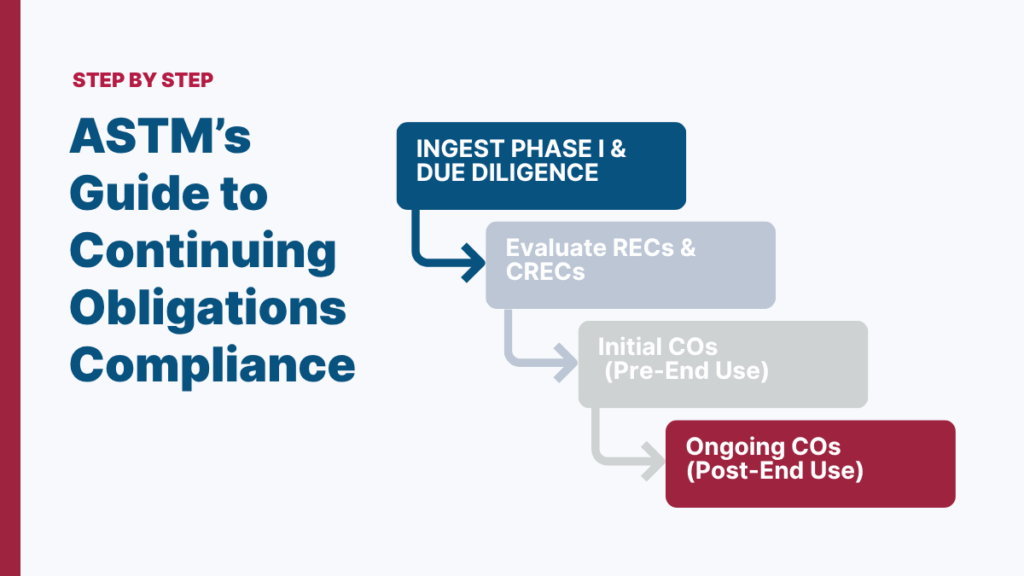
Steps 1 and 2 cover processes to ingest the Phase I report and any other pre-transaction due diligence, and recommend steps to understand and evaluate the RECs or CRECs (recognized environmental conditions and controlled recognized environmental conditions). Then, with that understanding, steps 3 and 4 recommend a process for addressing what the Standard Guide describes as initial and ongoing COs.
Initial COs are those required during the redevelopment timeframe, before end use. This category, which covers “reasonable steps” and “disposal” (the topics that have received the most attention in the courts), includes measures to responsibly manage and prevent the exacerbation of contamination.
Specifically, step 3 asks what reasonable steps are needed to control residual contamination until the property’s end use is in place, cleanup is certified, institutional controls are in place, and redevelopment is largely complete.
Ongoing COs, detailed in step 4, are those that apply after the end use is in place and help ensure the property owner is in compliance with the institutional controls. While the initial COs/step 3 situation is normally short-lived, ongoing COs (institutional control compliance) can last for a very long time. The Standard Guide helps stress and recommend programs for monitoring and ensuring institutional control compliance, which I’m personally seeing as becoming more routine as stakeholders increasingly come to appreciate the need for and the risks involved with institutional control failure.
CO Practice Adapting, Taking Hold
As I watch the evolution of CO practice, I think the distinction between initial COs (pre end-use) and ongoing COs (post end-use) has become more solidified and understood, with CO procedures adapting accordingly. The case law highlights the importance of initial COs (e.g., preventing exacerbation during redevelopment), and the slow but steady increase in attention to IC monitoring and compliance (speaking from personal experience) continues to motivate stakeholders to incorporate IC compliance into their cleanup and redevelopment strategies. In short, CO practice is taking hold.
Interested in learning more about how continuing obligations apply to your sites? Reach out directly to Mike at m.sowinski@terradex.com.